Balconies are valuable features in Florida hotels, condominiums, apartments, and other multi-story properties, but they also require regular attention to remain safe and functional. Exposure to Florida's sun, rain, humidity, salt air, and storms can contribute to deterioration of materials over time.
Understanding Florida balcony inspection requirements is therefore important for property owners, managers, condominium associations, and others responsible for maintaining elevated exterior areas. In 2026, it is especially important to understand which inspection requirement applies to a particular property because Florida has different inspection programs for different types of buildings.
Florida law contains specific balcony inspection requirements for certain public lodging establishments. Under Florida Statute 509.2112, every public lodging establishment that is three stories or more in height must file a certificate stating that its balconies, platforms, stairways, and railings have been inspected by a person competent to conduct the inspection and were found safe, secure, and free of defects. The certificate is filed initially and every three years thereafter with the Division of Hotels and Restaurants and the applicable local authority.
The Florida Department of Business and Professional Regulation provides DBPR Form HR-7020, Certificate of Balcony Inspection, for this purpose. The official form explains that the inspection applies to public lodging establishments three or more stories in height and includes balconies, platforms, stairways, railings, railways, guardrails, balustrades, parapets, and certain screened or enclosed areas.
Property owners should always verify the requirements applicable to their specific building rather than assuming that every balcony in Florida follows the same inspection schedule.
The three-year certificate requirement under Chapter 509 specifically addresses qualifying public lodging establishments that are three or more stories in height. Florida law also requires these establishments to maintain safe and secure railings on balconies, platforms, and stairways.
This distinction matters because the phrase “balcony inspection” can refer to different types of evaluations.
A hotel or other qualifying public lodging establishment may need the DBPR balcony certificate, while an aging condominium building may also be subject to Florida's separate milestone inspection requirements.
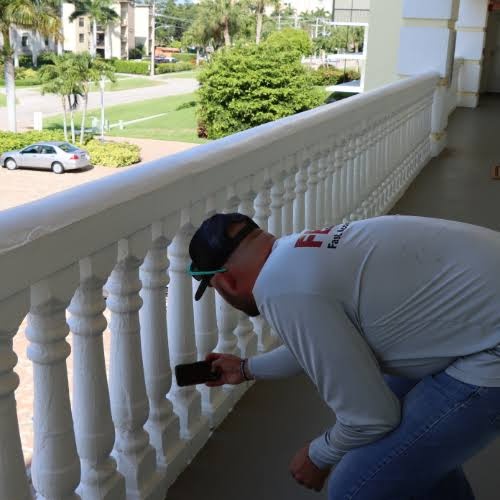
A professional balcony inspection is intended to identify visible conditions that could affect safety, security, or the condition of the inspected areas.
Depending on the property and inspection scope, an inspection may review:
The official HR-7020 form requires the inspector to certify whether the inspected balconies, platforms, stairways, railings, and railways were found safe, secure, and free of defects.
Florida's environment can be demanding on exterior building components. Persistent humidity and rainfall can contribute to moisture-related deterioration, while coastal properties may experience additional exposure to salt-laden air.
Water can become particularly concerning when it reaches cracks, joints, connections, or other vulnerable areas. Over time, repeated exposure can contribute to deterioration that may not be obvious from ground level.
Regular inspections can help property owners identify visible concerns earlier and determine whether additional evaluation or repairs may be appropriate.
For qualifying public lodging establishments that are three or more stories in height, Florida Statute 509.2112 establishes a three-year filing cycle for the balcony inspection certificate. The requirement began with filing commencing January 1, 1991, and continues every three years thereafter.
The DBPR also identifies HR-7020 as the certificate that public lodging establishments with three or more stories must file every three years.
However, property owners should not interpret the three-year interval as meaning that balconies only need attention once every three years. Routine maintenance, visual monitoring, and prompt investigation of visible damage remain important between formal inspections.
Condominium owners and associations should also be aware that Florida has a separate structural inspection program for certain condominium and cooperative buildings.
Under Florida Statute 553.899, buildings that are three habitable stories or more and subject to condominium or cooperative ownership are generally subject to milestone inspection requirements tied to the building's age. The statute establishes an initial milestone inspection when the building reaches 30 years of age, followed by inspections every 10 years, subject to the law's specific provisions and exceptions.
A milestone inspection is different from a DBPR balcony inspection. It is a structural inspection conducted by a licensed architect or engineer and addresses the building's major structural components and systems.
Therefore, condominium associations should determine which statutory requirements apply to their building rather than treating a balcony inspection and milestone inspection as interchangeable.
Finding a defect does not necessarily mean that an entire property is unsafe, but it does mean the condition should be properly evaluated and addressed.
Depending on the severity and type of issue, the next step could involve repair, maintenance, additional testing, or evaluation by an appropriately licensed professional.
For qualifying public lodging establishments, the HR-7020 certificate includes fields for the number of areas inspected, defects found, and the date repairs were completed.
Property owners should keep inspection reports, certificates, repair records, and other relevant documentation organized. Good records can make future inspections and maintenance planning easier.
Property managers and building owners can make the inspection process more efficient by ensuring that balconies and related areas are accessible.
Before an inspection, consider:
Most importantly, inspection preparation should focus on improving access and documentation rather than concealing defects.
Understanding Florida balcony inspection requirements is an important part of responsible property management. For qualifying public lodging establishments, Florida law establishes a three-year balcony inspection certificate requirement, while certain condominium and cooperative buildings are subject to a separate milestone inspection program.
Because the applicable requirements depend on the property's use, height, ownership structure, age, and other factors, owners and managers should confirm the rules that apply to their specific building.
A proactive approach to balcony inspections can help identify visible deterioration, support proper maintenance, and provide valuable information about the condition of elevated exterior areas. In Florida's demanding climate, regular attention to balconies is not simply about compliance—it is also an important part of responsible property care and occupant safety.

This post has been authored and published by one of our premium contributors, who are experts in their fields. They bring high-quality, well-researched content that adds significant value to our platform.