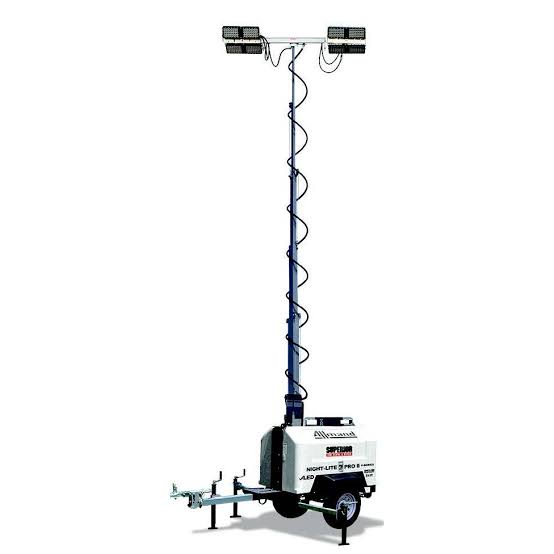
How many lighting towers do we need?" is one of the most common questions asked when planning night work, outdoor events or temporary site lighting. It is also one of the most frequently answered by guesswork.
Getting the number wrong has real consequences. Too few towers leave dark areas where people trip, vehicles collide and work slows down. Poor lighting is a recognised contributor to accidents on construction sites and roadworks, and it can also leave a site vulnerable to theft and trespass. Too many towers create a different set of problems: higher rental and fuel costs, unnecessary noise and emissions, more glare and more light spilling into neighbouring properties.
The right answer depends on the size of the area, the type of work, the light level required and the output of the towers themselves. This guide sets out a straightforward method for estimating how many towers your site needs, with a worked example and the practical factors that can change the final number.
Two units are essential for lighting calculations.
Lumens measure the total amount of light a lamp produces. A typical LED lighting tower with four lamp heads may produce somewhere between 100,000 and 160,000 lumens in total, depending on the model. Older metal halide towers often produce similar or higher raw output but use far more fuel.
Lux measures how much light actually reaches a surface. One lux equals one lumen spread over one square metre. Lux is what matters for safety and productivity, because it describes how bright the working area really is.
Not all the light a tower produces reaches the ground where it is needed. Some spills beyond the work area, some is absorbed and some is lost as lamps and lenses get dirty. This is why a direct conversion from lumens to area always overestimates coverage.
Different activities need different amounts of light. Typical targets for outdoor work are:
| Area or activity | Typical target (lux) |
|---|---|
| Perimeter security and general site movement | 10 to 20 |
| Walkways, car parks and storage areas | 20 to 30 |
| General construction, earthworks and loading | 50 to 100 |
| Detailed work, inspection and fitting | 150 to 300 |
These figures are general guidance. Always check any legal minimums or industry standards that apply to your site or country.
Divide the site into zones based on activity. Lighting a whole site to the level needed at the busiest work face wastes both money and fuel. Zoning is often the single most effective way to reduce the number of towers required.
Use a site plan to calculate the area of each zone in square metres. For irregular shapes, break the area into rectangles and add them together. Remember to include access routes, entrances and any areas where people or vehicles will move after dark.
The basic formula for each zone is:
Number of towers = (Area × Target lux) ÷ (Tower lumens × Utilisation factor × Maintenance factor)
The utilisation factor accounts for light that falls outside the target area. For outdoor floodlighting, it is commonly between 0.4 and 0.6. The maintenance factor allows for dirt on lenses, dust in the air and gradual loss of lamp output. A value of around 0.8 is typical.
Always round the result up to the next whole tower.
Imagine a construction site of 10,000 square metres. It contains an active work area of 3,000 square metres that needs 50 lux, and 7,000 square metres of storage, parking and access routes that need 20 lux. The chosen LED towers produce about 150,000 lumens each.
Using a utilisation factor of 0.5 and a maintenance factor of 0.8, each tower delivers about 150,000 × 0.5 × 0.8 = 60,000 useful lumens.
Work area: 3,000 × 50 = 150,000 lumens needed. 150,000 ÷ 60,000 = 2.5, rounded up to 3 towers.
Storage and access: 7,000 × 20 = 140,000 lumens needed. 140,000 ÷ 60,000 = 2.3, rounded up to 3 towers.
The site needs about 6 towers in total.
Now compare this with lighting the whole site to 50 lux: 10,000 × 50 = 500,000 lumens, divided by 60,000, gives 8.3, rounded up to 9 towers. Zoning the site saves three towers, along with their fuel, servicing and emissions.
A calculation tells you how much light is needed, but not whether it reaches every corner. Long, narrow areas such as haul roads, fence lines and trenches may need more towers than the formula suggests, simply because light from a single tower cannot reach their full length. Large obstacles such as buildings, cranes and stacked materials can also block light and create shadows that require an extra unit.
Plot the proposed tower positions on a site plan, using the manufacturer's coverage diagram if available. Check that pools of light overlap, that no important area is left in shadow and that each tower can be placed safely on firm, level ground.
Mast height. Towers raised to their full height, typically seven to nine metres, spread light over a wider area and produce more even coverage. If height restrictions or overhead lines force masts to be lowered, you may need more units.
Lamp technology. LED towers deliver more useful light per litre of fuel than older metal halide models, and their light can be directed more precisely. Solar and battery hybrid towers are ideal for lower-intensity zones such as car parks and perimeters.
Uniformity requirements. Some tasks, such as surveying, road marking or detailed inspection, need very even light with minimal contrast. Achieving good uniformity often requires more towers at closer spacing.
Operating hours and redundancy. For sites operating through the night, it may be sensible to include one spare tower, so that a breakdown or refuelling stop does not leave an area unlit.
Changing site conditions. Construction sites evolve. As structures rise, excavations open and work areas move, the lighting plan must be reviewed and towers repositioned or added.
Environmental limits. Near homes, roads, airports or wildlife areas, restrictions on glare and light spill may require lower-intensity towers, more careful aiming or additional units at lower output.
For early budgeting, before a detailed calculation is carried out, the following rough guide can help. A modern four-lamp LED tower at full height can typically light around 2,000 to 4,000 square metres to about 20 lux, or around 1,000 to 1,500 square metres to about 50 lux. Actual performance varies significantly by model, so always confirm figures with your supplier.
Working out how many lighting towers your site needs is not complicated, but it does require more than guesswork. Set target light levels for each zone, measure the areas, apply the formula with realistic utilisation and maintenance factors, and then check the layout on a site plan for shadows and gaps.
This approach typically results in fewer towers, lower fuel costs and better, safer lighting. When planning a new project, ask your tower light rental supplier for lumen output data and coverage diagrams for the specific models you are considering. With accurate figures and a zoned plan, you can light your site effectively without paying for light you do not need.

This post has been authored and published by one of our premium contributors, who are experts in their fields. They bring high-quality, well-researched content that adds significant value to our platform.